A Strategic Ban with Global Implications
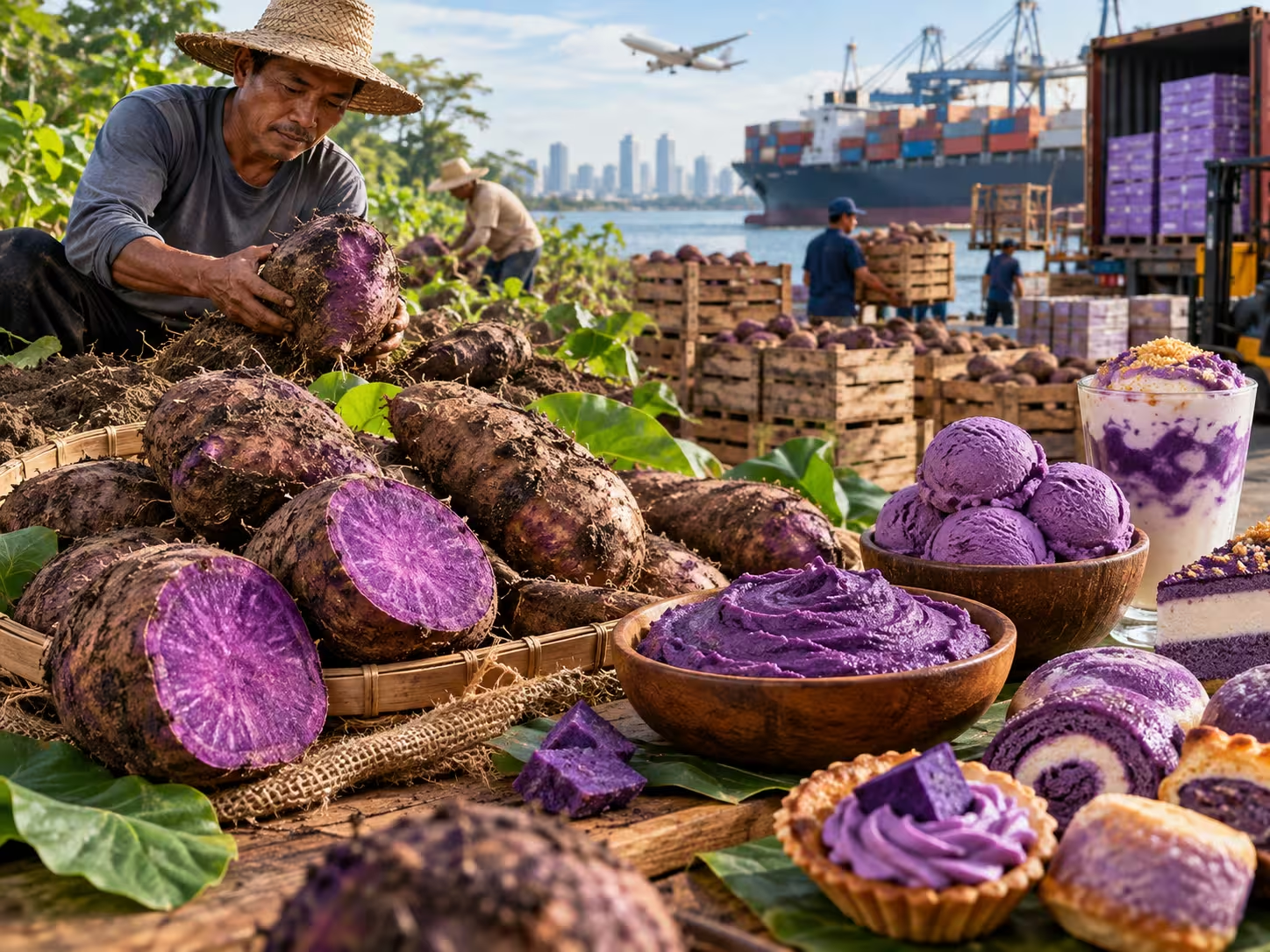
In September 2026, the Philippine Department of Agriculture announced a policy that sent ripples through the global food industry: an indefinite suspension of fresh purple yam exports . The rationale was straightforward yet strategic—the Philippines needed to shore up scarce planting materials to expand domestic production and protect its competitive advantage. The ban is likely to last until 2028, applying only to ube meant for planting .
The move reflects a deeper understanding of the geopolitical economy of agricultural commodities. As one of the world’s primary sources of ube, the Philippines faces a classic dilemma: exporting raw materials enriches foreign competitors who may eventually cultivate their own supply and compete directly with Philippine producers. “The real competition is not among Filipino ube growers but with our ASEAN neighbors,” Agriculture Secretary Francisco P. Tiu Laurel Jr. said .
The Planting Material Crisis
At the heart of the ban is a fundamental biological constraint. Ube is propagated through cut tubers rather than seeds, meaning every tuber exported for consumption or planting is a tuber that cannot be used to expand domestic production . With global demand surging and Philippine production struggling to keep pace, the government made a calculated decision to prioritize long-term supply security over short-term export revenue.
The numbers underscore the urgency. The Philippines produced approximately 12,483 metric tons of ube in 2025, a 6.7% decline from the previous year . This shortfall forced the country to import frozen ube from Vietnam—10,482 kilos in the first four months of 2026 alone—just to meet domestic processing demand .
Impact on Farmers and Exporters
For Filipino farmers, the ban has had mixed effects. On one hand, domestic prices have risen sharply, from around 30-50 pesos per kilogram a few years ago to 150 pesos per kilogram in 2026 . This price increase has boosted farm incomes and made ube cultivation more attractive.
On the other hand, exporters of raw ube have seen their businesses disrupted. However, the policy explicitly permits the export of processed ube products such as powder, puree, and halaya, encouraging a shift toward value-added exports . This aligns with the broader strategy of moving up the value chain and capturing more economic value domestically.
Global Market Repercussions
For international food brands, the ban has introduced new sourcing uncertainties. F&B manufacturers are exploring processed formats, alternative suppliers, and even purple substitutes to manage sourcing risks . The global ube market’s growth trajectory—projected to expand from USD 520.3 million in 2026 to USD 830.0 million by 2033—remains intact, but the supply landscape is shifting .
Countries with suitable agronomic conditions may accelerate efforts to cultivate their own ube supply. “If ube continues to gain international traction, other producing countries and commercial growers may look to cultivate their own supply to reduce import dependence,” noted BMI, Fitch Solutions’ analytics unit .
A Calculated Gamble
The export ban represents a calculated gamble that short-term export restrictions will yield long-term industry strength. The DA has backed this strategy with significant resources, including a P300 million budget for the ube industry in 2027 approved by President Ferdinand R. Marcos Jr. . Whether this gamble pays off depends on whether the Philippines can successfully expand production, improve planting material availability, and maintain its quality advantage in global markets.