
The Cebu Gambit
For decades, the Philippine concert economy had a single gravitational center: Metro Manila. Fans from Cebu, Davao and the wider Visayas-Mindanao corridor flew to the capital for international tours, spending on airfare what they could have spent on better seats, hotel nights and local experiences. The opening of the 25,000-seat SM Seaside Cebu Arena in June 2026 is the first serious attempt to break that monopoly.
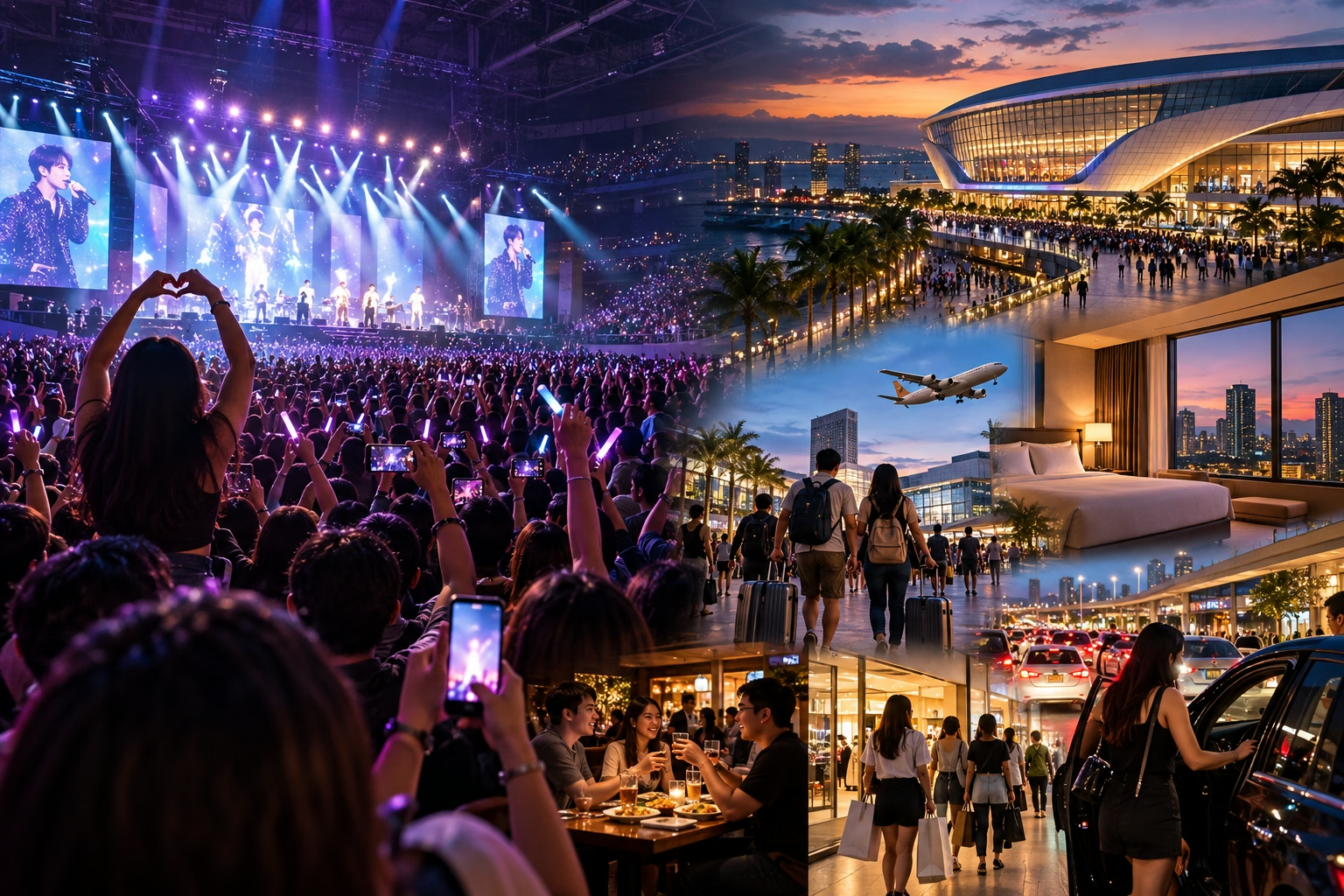
SM Prime has not been subtle about the strategy. The company lined up more than 20 major shows at the Cebu venue in 2026, and it is positioning the arena as a regional growth center rather than a satellite of Manila. The location is deliberate: inside the SM Seaside Complex, near Mactan-Cebu International Airport, surrounded by hotels, retail and transport links. The pitch to promoters is straightforward—turn a concert into a destination event, not a single night’s transaction.
A Destination, Not Just a Venue
The early signals are strong. SM Prime’s three major live venues—MOA Arena, SM Seaside Cebu Arena and SMDC Festival Grounds—collectively welcomed more than one million visitors in the first eight months of 2026, a 52% increase from the same period a year earlier. The MOA Arena hosted over 110 shows from January to August, up 20% year-on-year, while the Cebu arena opened with sold-out Filipino acts and is already feeding a 2027 pipeline that includes Westlife, The Script, Maroon 5 and BIGBANG.
The significance is not just that Cebu now has a large venue. It is that the venue changes the economics of touring the Philippines. A promoter can now route a regional tour through Manila and Cebu without building a separate production from scratch, and Visayas-Mindanao fans can redirect travel spending into their own region. SM Prime President Jeffrey Lim has described the arena as a way to “attract major events, support tourism, and create more economic activity for the region,” and the company is already treating the Cebu model as a template for integrated-estate traffic.
The Next Test: Sustaining the Pipeline
Arena construction is the easy part. The harder work is building a year-round event calendar that does not depend on a handful of marquee tours. SM Prime is aware of the risk: it is simultaneously expanding its 2027 slate and investing in ticketing technology and venue systems to improve access and production quality. The company’s venue traffic jump in 2026 was driven not only by international acts but by sporting events, family shows and local productions, a diversified mix that reduces reliance on any single genre or promoter.
The regionalization of the concert economy also creates an opening for local creative workers outside Metro Manila. Production crews, stylists, technicians, event staff and content creators in Cebu and nearby provinces can now access work that previously required relocation to the capital. Whether that translates into durable careers depends on how consistently the arena pipeline is filled—and whether the surrounding ecosystem of rehearsal spaces, production suppliers and creative agencies grows alongside the venue.
Cebu is not replacing Manila. It is forcing the Philippine concert economy to become a multi-city network, and that shift is likely to define the next decade of live entertainment in the country more than any single sold-out show.