Speed as a Competitive Layer
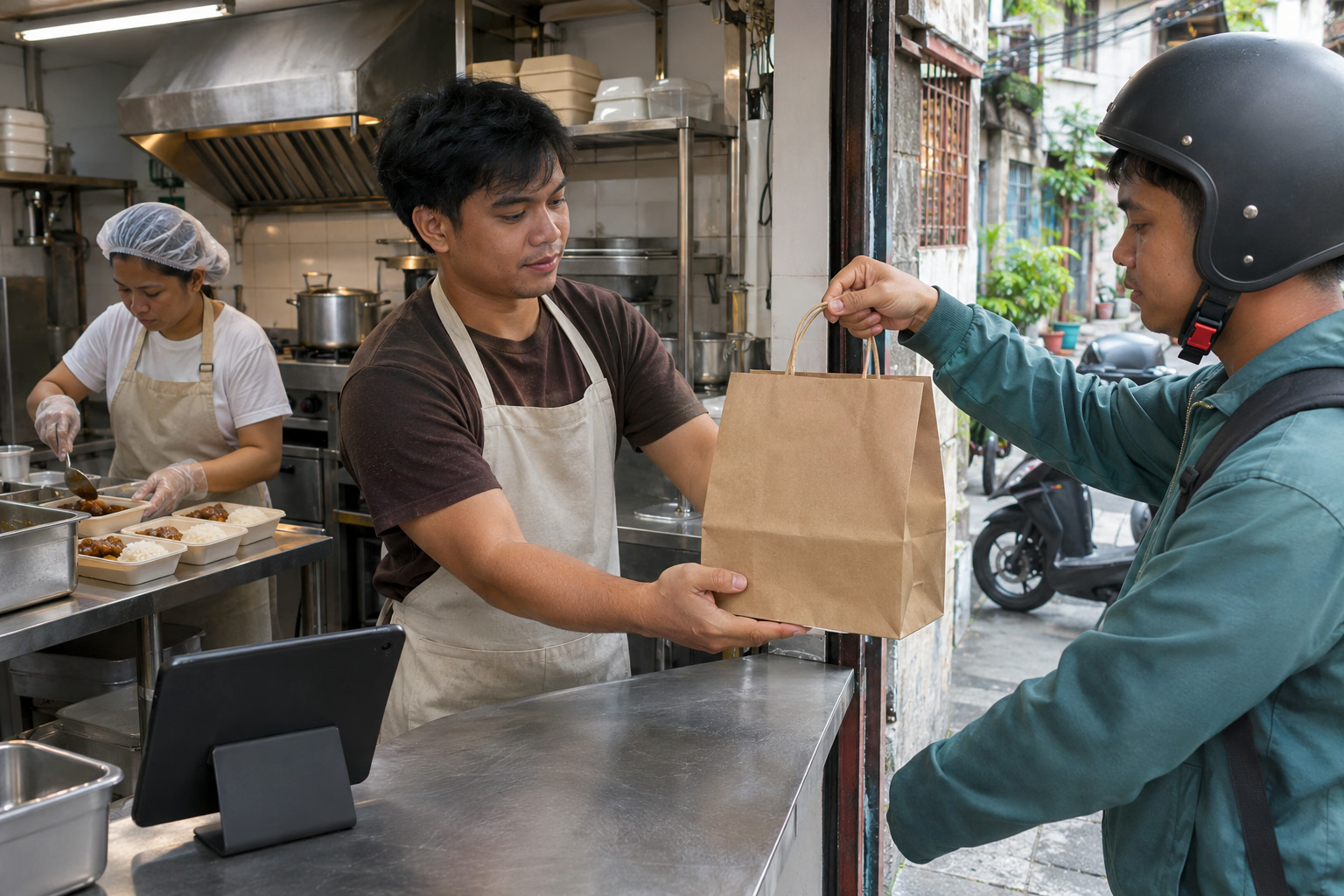
Standard delivery platforms in the Philippines typically promise windows of 30 to 45 minutes, a timeline that struggles against Metro Manila’s traffic realities, where average commutes can exceed 45 minutes during peak hours. Instant delivery—targeting 15 to 30 minutes through localized fulfillment, optimized routing, and dark kitchen partnerships—has moved from a pilot concept to an operational differentiator in key urban districts.
Foodpanda Express has already tested faster delivery through dark kitchen collaborations in Bonifacio Global City, Makati, and Quezon City. Grab’s delivery network, meanwhile, has extended beyond food into same-day parcel logistics, with restaurant partners in high-density areas reporting shorter average times. The implication for cloud kitchens is direct: proximity to demand is no longer merely a cost decision; it is a ranking and conversion decision.
Platform-Exclusive Brands and the Visibility Trade-Off
The two major platforms do not treat cloud kitchens identically. Foodpanda carries a deeper catalog of exclusive cloud kitchen brands spanning Thai, Indian, and other delivery-optimized cuisines, while GrabFood maintains fewer exclusive virtual brands. For an operator, platform selection is therefore not just a commission negotiation—it is a decision about which app’s algorithm and user base are most compatible with the brand’s positioning.
This asymmetry also shapes promotional strategy. A cloud kitchen brand that exists only on one platform inherits that platform’s demand density but surrenders pricing leverage. A multi-platform presence broadens reach but fragments operational focus and multiplies menu-management complexity.
The Infrastructure Behind the Speed Promise
Instant delivery is not simply a setting that can be switched on. It demands menu items with short preparation times, pre-portioned ingredients, packaging engineered for rapid handoff, and kitchen locations selected for rider accessibility rather than customer visibility. Cloud kitchen operators experimenting with instant models are effectively redesigning their back-of-house workflows around a 15-minute throughput target—a fundamentally different operational discipline from the standard 45-minute delivery kitchen.
The commission structure reflects this premium. Instant and express tiers carry higher platform fees, with GrabFood’s instant range reaching 18–25% and Foodpanda’s fast tier spanning 17–24%. Those fees are partially offset by higher average order values, as customers opting for speed tend to order more per transaction. The economics only work when the kitchen can consistently meet the speed promise without sacrificing food quality or incurring refund costs.