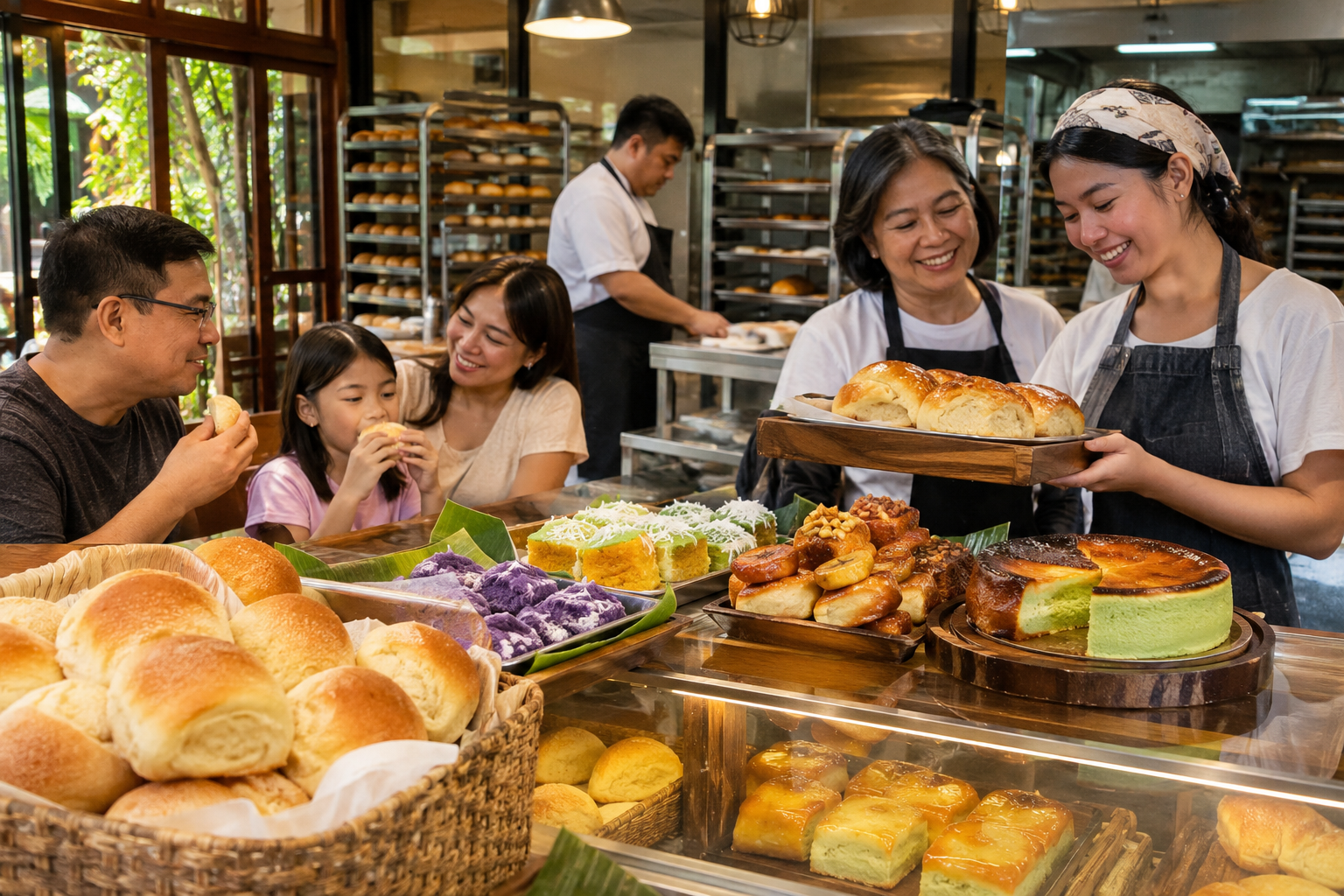
Beneath the romantic narrative of craft and heritage lies a harder truth: the Filipino bakery revival is unfolding under conditions of genuine economic distress for the smallest players. The panaderya that anchors a barangay—open before dawn, selling pandesal at two pesos a piece—operates on margins so thin that a single spike in liquefied petroleum gas prices can erase a week’s profit. Understanding the revival requires understanding what these bakeries are surviving, not just what they are creating.
The Anatomy of a Squeeze
The numbers tell a story of compounding pressures. The Philippine bakery market was valued at roughly USD 3.7 billion in 2025, with bread representing the largest category by volume . Yet the industry’s dependence on imported inputs—flour, butter, yeast, even salt—exposes every neighborhood bakery to forces far beyond its control . When global wheat prices surge or the peso weakens, the effect travels down the supply chain with brutal efficiency.
The Philippine Star reported in April 2026 that Bakery sa Pureza, a 41-year-old community institution in Manila, has kept its pandesal at two pesos despite operating costs that have risen sharply. The second-generation owner, Isiah Bucao, described a deliberate strategy of absorbing costs: cutting operating hours, eliminating free plastic bags, and strictly limiting oven use to morning hours . The bakery’s customers are students and tricycle drivers. Raising the price by even a peso would, in Bucao’s assessment, break a social contract as much as a business model.
The Shrinkflation Dilemma
Other bakeries have taken a different path. Albeth Bakehouse in Sampaloc reduced its pandesal from 30 grams to 20 grams before accepting a PHP 25,000 assistance package from the Manila city government, which came with the condition that prices for basic breads remain frozen for a month . The arrangement is pragmatic but reveals the fragility of the underlying economics. A bakery cannot shrink a roll indefinitely without destroying the product’s identity. At some point, the pandesal ceases to be pandesal.
This tension between affordability and sustainability defines the current moment. The revival of traditional breads and kakanin is real, but it is not evenly distributed. Artisan bakeries in BGC and Makati can charge premium prices for sourdough pandesal because their customers can afford them. The bakery in Pureza cannot. Both are part of the same story, but they occupy different economic realities.
What Resilience Actually Looks Like
The community bakery’s survival strategy is rarely dramatic. It is the decision to reopen after a fire, as Bakery sa Pureza did in early 2026, serving the same Spanish bread that sold out before noon for decades . It is Chito Chavez of Tinapayan Festival folding malunggay and kalabasa into pandesal to add nutritional value without abandoning the form . It is Wilson Flores of Kamuning Bakery, operating since 1930, keeping the doors open through a pandemic and a fire because closing would mean more than losing a business .
These are not stories of triumphant disruption. They are stories of endurance, adaptation, and the quiet calculus of what a community can bear to lose. The revival, seen from this angle, is less about innovation than about refusing to disappear. That refusal is itself a kind of statement—about the place of the panaderya in Filipino life, and about what a two-peso pandesal actually costs to keep on the shelf.