Beyond the Gym: How Remote Patient Monitoring Is Finding Its Way into Filipino Homes and Hospitals
The first wave of wearable health technology in the Philippines was consumer-driven: step counts, workout minutes, sleep scores. The second wave is institutional, and its unit of adoption is not the individual user but the household and the hospital ward. Remote patient monitoring (RPM) devices in the Philippines are forecast to grow at a 12–16% CAGR through 2035, with wearable monitors and portable vital-sign devices accounting for an estimated 55–65% of device-segment demand. That demand is pulling wearables into care pathways where the data has a clinical destination.
A Pediatric Heart Center Tests the Model
In February 2026, the Philippine Heart Center received donated wearable devices from mWell, the digital health platform affiliated with Metro Pacific Group, designated for selected pediatric patients. The devices are designed to monitor vital signs and support proactive management beyond the hospital walls, extending cardiac care into the intervals between consultations. For pediatric cardiac patients, the value proposition is not novelty; it is continuity. A child’s heart rhythm and oxygen trends do not pause when the family leaves the ward, and a wearable that transmits those signals gives clinicians a view into the home environment that a follow-up appointment cannot replicate.
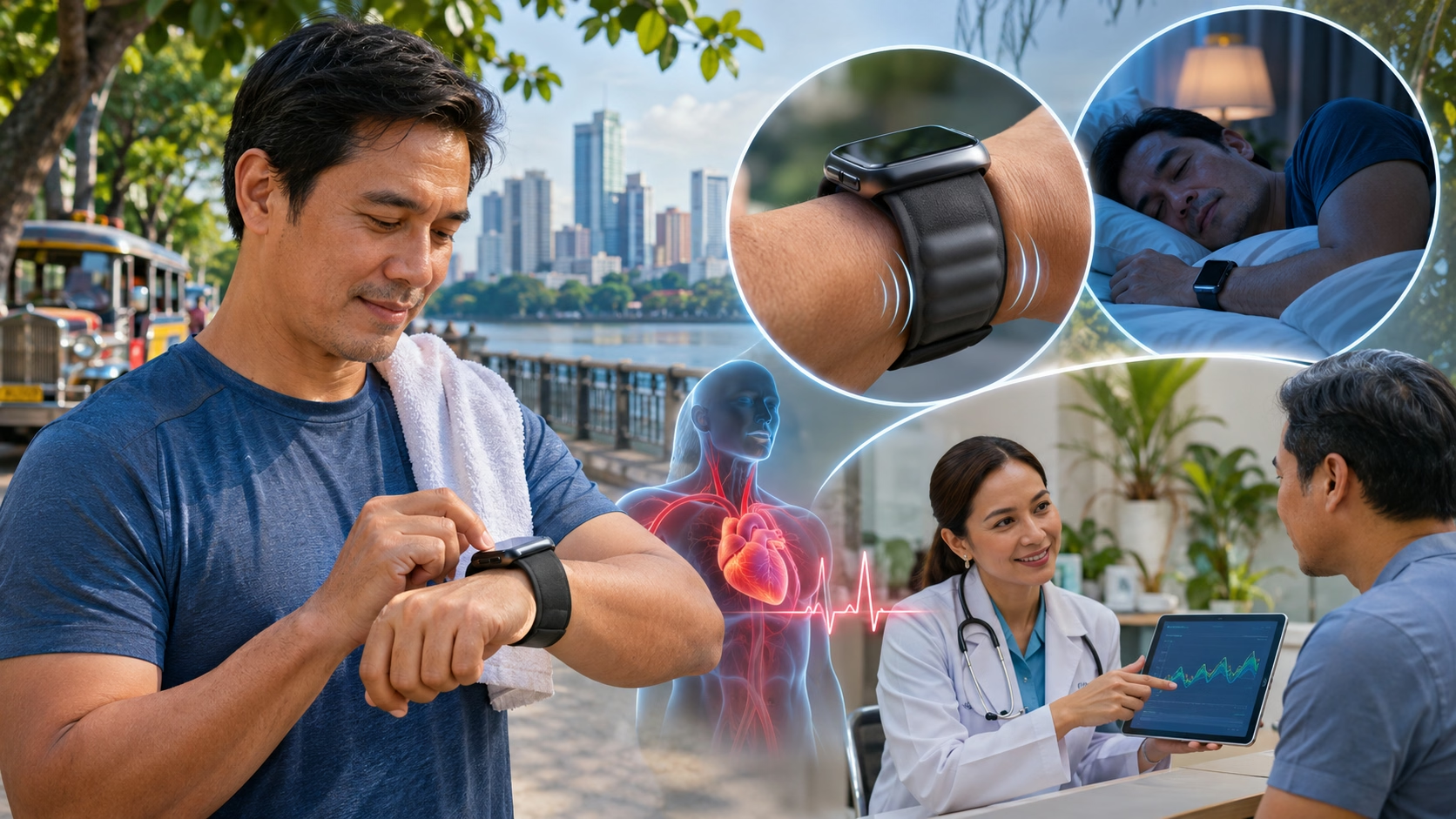
The same logic is scaling through household dashboards. mWell’s Fam Dashboard allows subscribers to track health metrics for multiple family members in real time, while PLDT Home Fiber customers receive an mWell Prestige Watch that syncs steps, heart rate, and sleep quality into the platform. The household—not just the individual—becomes the unit of monitoring, which matters in a country where caregiving is often distributed across family members.
The Affordability Variable
Remote monitoring only reaches scale if the devices reach price points that ordinary households can absorb. mWell’s wearable lineup illustrates the range: the Prodigy watch at PHP 1,999, the Power at PHP 2,499, the Prestige at PHP 2,999, the Prestige Sport at PHP 3,499, the Smart Ring at PHP 8,999, and the ECG Ring at PHP 13,999. The lower tiers cover heart rate, SpO2, sleep, and activity; the ECG Ring adds an electrical heart sensor for rhythm readings. The pricing strategy is explicit: make core monitoring accessible first, then let clinical depth tier upward.
From Data Collection to Care Coordination
The unresolved challenge is not data capture but data routing. A wearable that logs a week of nighttime oxygen desaturation is only clinically useful if that pattern reaches a clinician who can act on it. The Universal Health Care Act’s push toward integrated health information systems provides the policy scaffolding, mandating digital technologies for patient monitoring with data privacy compliance under the Data Privacy Act. What remains is the operational layer: which clinician receives the alert, under what protocol, and with what reimbursement pathway. RPM’s Philippine growth curve will be determined less by sensor capability than by the care coordination infrastructure built around the data.