Historical tourism in the Philippines opens a window into a nation whose identity was forged through centuries of foreign contact, colonization, and resistance. While many people associate the country with islands and coastlines, its historical landmarks offer equally powerful reasons to visit. Spanish colonization lasted more than 300 years and left a profound influence on religion, settlement patterns, and architecture. The succeeding American regime reshaped governance and education, while the Japanese occupation during World War II left scars that remain visible in memorial sites. Together, these periods created a historical tapestry that makes the Philippines one of the most meaningful cultural destinations in Asia.
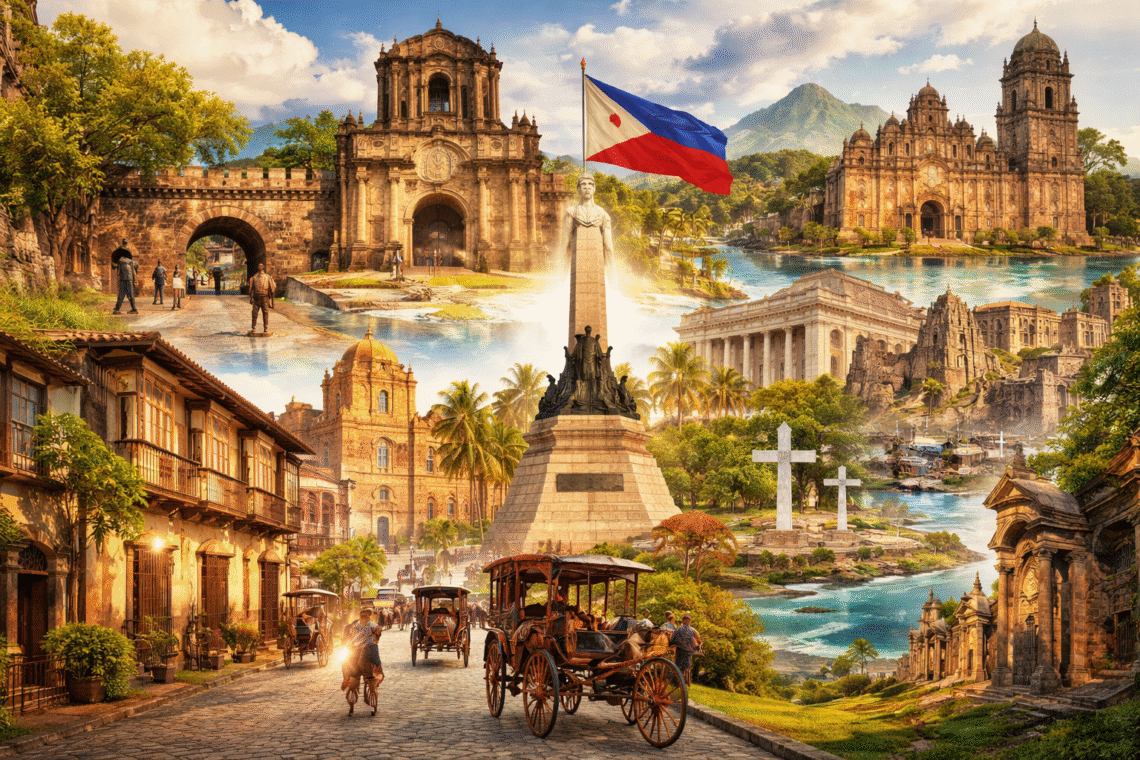
Among the country’s most recognizable heritage areas is Intramuros, the old Spanish center of Manila. This district was designed as a heavily fortified colonial capital, enclosed by stone walls and surrounded by moats and defensive works. Its physical layout represented the priorities of empire: security, religious authority, and administrative control. Within Intramuros, visitors find cathedrals, convent complexes, military structures, and official residences that illustrate the social order of the colonial period. One of the most visited places inside the walls is Fort Santiago, which served both military and political purposes. It is remembered not only for its role in defense but also for its connection to José Rizal, whose imprisonment there transformed the fort into a symbol of sacrifice and awakening nationalism.
The role of the Catholic Church in shaping Philippine history is especially clear in the country’s religious monuments. Spanish colonization relied heavily on missionary expansion, and churches became centers of both spiritual and civic life. In many towns, the church plaza formed the nucleus of settlement, with municipal buildings and markets nearby. This model can still be seen across the archipelago. San Agustin Church in Manila is particularly important for its age, artistic heritage, and resilience. Beyond Manila, churches such as Paoay Church are notable for their massive buttresses and earthquake-resistant design, showing how European forms were modified in response to local geography. These sacred structures help visitors understand how colonialism worked not only through force but also through ritual, education, and community organization.
Another essential place for heritage travelers is Vigan, a city that preserves the atmosphere of a colonial trading center. What makes Vigan especially valuable is that it represents a lived environment rather than a single landmark. Its preserved streetscape, ancestral houses, and merchant quarters demonstrate how commerce, social rank, and family life operated under colonial rule. The city also reflects the blending of Spanish and Asian influences, particularly through its architecture and urban economy. This multicultural character challenges simplistic views of colonial history and shows that the Philippines was part of wider global and regional networks.
The American period introduced a very different colonial model. Rather than focusing primarily on mission settlements and fortifications, the United States promoted schools, public institutions, road networks, and administrative buildings. This influence remains visible in civic centers and educational campuses. Wide boulevards, public parks, and neoclassical government architecture illustrate the American emphasis on modern state-building. Yet these structures also remind visitors that modernization occurred within a colonial framework, where reform and domination operated together.
World War II heritage adds another layer to the country’s historical appeal. Corregidor Island, the ruins of wartime Manila, and military cemeteries preserve memories of invasion, resistance, and liberation. These destinations allow visitors to engage with the Philippines not only as a colonial possession but as a major site of conflict in the Pacific. They highlight courage, suffering, and the destruction of cultural treasures, many of which had to be rebuilt after the war.
To explore the historical sites of the Philippines is to encounter the many forces that shaped the nation. Colonial walls, baroque churches, ancestral homes, civic buildings, and war memorials each tell part of the story. Together, they reveal how the country transformed foreign influence into a layered and resilient cultural identity.