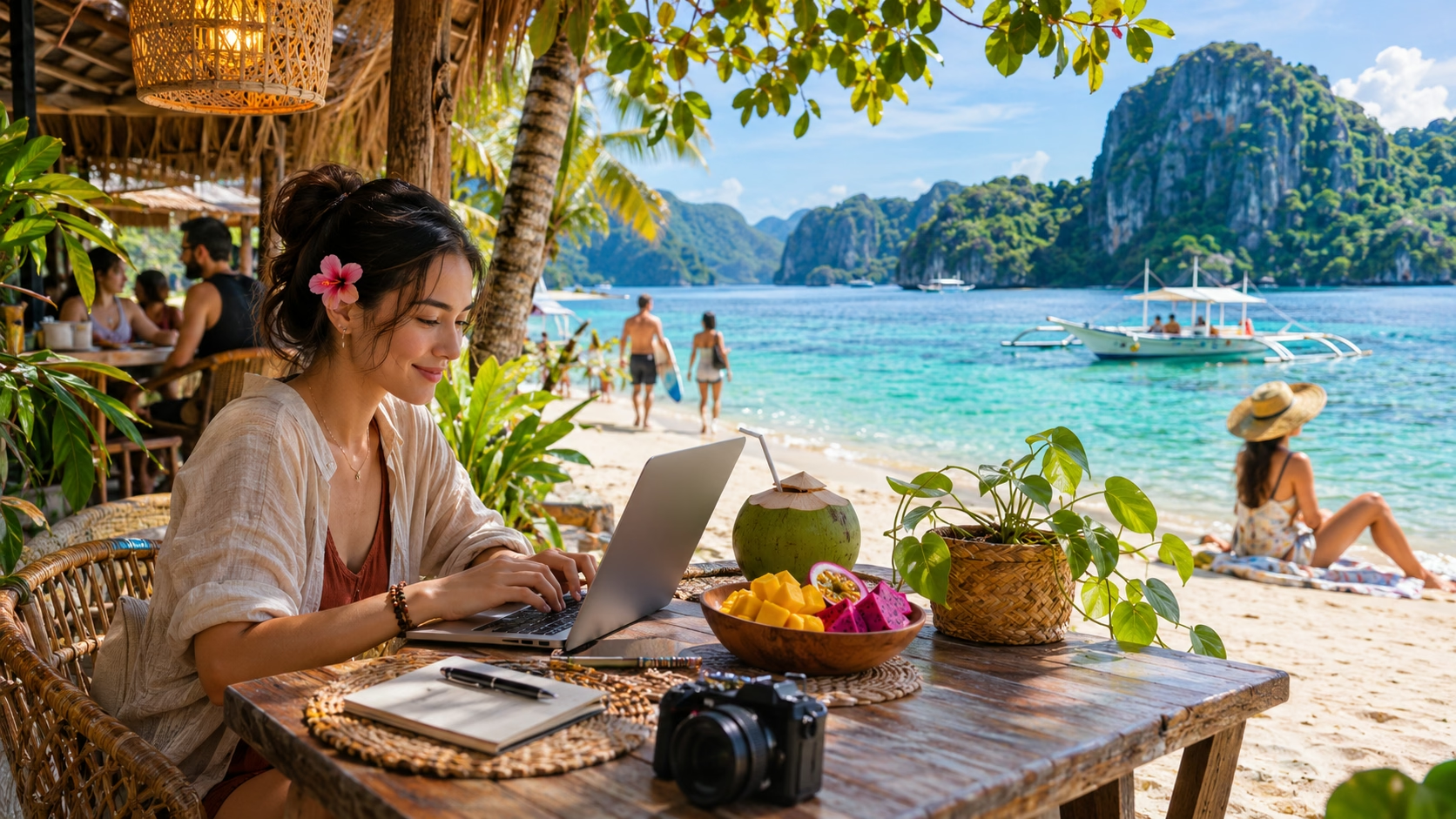
Siargao is no longer a secret. In 2026, the teardrop-shaped island in the Philippine south is a thriving global community, and the reason is not a new resort or a marketing campaign. It is the emergence of a working island rhythm—a place where the surf break, the café laptop and the sunset bridge occupy the same day without contradiction.
The Island That Learned to Sit Still
Travel writing on Siargao in 2026 describes a place where foreigners are drawn to its “island time” rhythm, where genuine hospitality meets a vibrant digital-nomad scene, and where a fierce commitment to sustainable tourism and plastic-free living has become part of the island’s identity. The practical infrastructure has followed. Electric scooters rent for roughly ₱350–₱500 per day, and solar-powered e-trikes now patrol General Luna, a small but telling signal that the island is trying to grow without paving over the thing people came for.
The Café-Coworking Ecosystem
The comparison with quieter islands makes the point. Siargao developed “a proper café culture—good coffee, decent wifi, places to sit with a laptop for four hours,” and it has become “a real digital-nomad base” in a way that Camiguin has not. For a remote worker, that ecosystem is not a luxury; it is the difference between a two-week holiday and a two-month stay. The island has the social side too—hostels, group tours, bars and a scene that absorbs newcomers—which matters for solo travellers who want to work remotely without working alone.
The National Digital Backbone
Siargao’s nomad scene is supported by a national connectivity story that has changed substantially. The Philippines recorded a median mobile download speed of 96.84 Mbps and fixed broadband of 188.00 Mbps in Ookla’s June 2026 index, against 98 million internet users and 83.8 percent penetration at the end of 2025. Island-level performance still varies with congestion, weather and local network capacity, and travellers should not read national figures as a guarantee for any single island. But the trend is unmistakable: the digital foundation now exists for island destinations to host visitors who stay weeks rather than days.
The Visa Reality for Long Stays
The legal framework is catching up more slowly. Most nationalities arrive visa-free for 30 days, extendable to 59 days at any Bureau of Immigration office and then further in 29-day increments, in practice allowing stays of many months. The Philippines does not yet have a dedicated digital-nomad visa; a Senate bill proposing one-year remote-work status was introduced in early 2025, and destinations such as Cebu, Siargao and Palawan are already seeing a rise in long-term visitors in anticipation. In the meantime, the in-country extension route is straightforward, which is precisely why slow travellers treat the Philippines as a place to settle rather than a place to pass through.
The Tension the Island Has to Manage
Siargao’s success carries its own warning. The island “went from a secret to the Philippines’ most talked-about island in about a decade,” with the crowds and developed prices to match. The slow-travel movement on Siargao is therefore not only about attracting longer stays; it is about protecting the conditions that make long stays desirable—the surf, the lagoon, the plastic-free commitment and the local culture that the island’s travel identity now rests on. The next chapter of Siargao’s slow-travel story will be written in how it balances the two.