
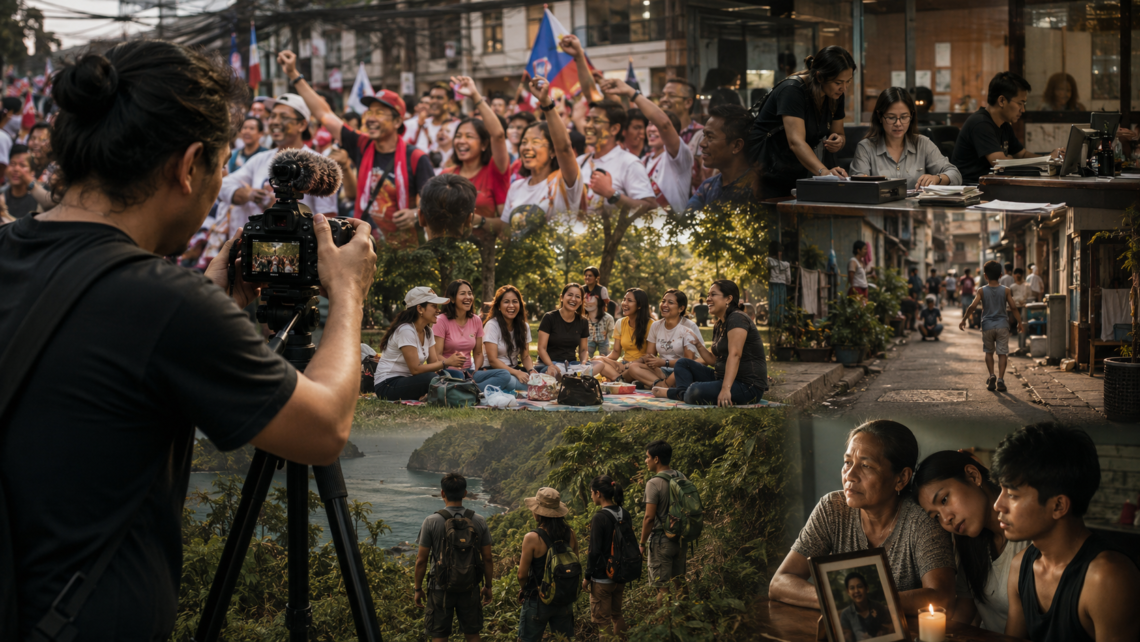
A documentary camera in the Philippines can point almost anywhere and encounter a different version of the country.
It may follow an election campaign in Manila, a family searching for a disappeared activist, domestic workers spending Sunday in Hong Kong, residents living through the drug war, or environmental defenders protecting forests in Palawan.
That breadth is one reason Philippine documentary filmmaking cannot be reduced to a single dominant subject. The country’s nonfiction cinema is shaped by political conflict, regional diversity, migration, economic inequality, and a long struggle over how national history should be remembered.
The strongest films do not merely report these issues. They show how large events enter ordinary lives.
Political History Becomes Personal
In And So It Begins, filmmaker Ramona S. Díaz examines the atmosphere surrounding the 2022 Philippine presidential election. The documentary, which premiered at Sundance in 2024, follows the energy of political campaigning while also observing the pressures facing journalism and democratic participation.
The film expands on concerns visible in Díaz’s earlier work, A Thousand Cuts, which follows journalist Maria Ressa amid battles over press freedom and online disinformation.
Both films demonstrate a defining feature of modern Philippine documentaries: national institutions are often explored through individual people whose choices reveal the larger system.
JL Burgos’s Alipato at Muog makes that connection even more direct. The documentary investigates the 2007 disappearance of the filmmaker’s brother, Jonas Burgos. Its 2024 classification controversy added a new chapter to the film’s story, turning questions about a past disappearance into a current debate over censorship, memory, and freedom of expression.
The documentary therefore operates on two levels. It is a family’s search for answers and a test of how openly unresolved political cases can be discussed.
Overseas Workers Tell a Different National Story
Philippine identity is not limited by the country’s geographical borders.
Sunday Beauty Queen, directed by Baby Ruth Villarama, documents Filipino domestic workers in Hong Kong who organize and join beauty pageants during their days off. The film gives audiences a perspective rarely visible in discussions about overseas labor.
Economic reports usually focus on employment and remittances. The documentary instead shows friendship, creativity, exhaustion, aspiration, and the emotional cost of living far from home.
By doing so, it demonstrates how documentaries can challenge familiar public labels. “Migrant worker” becomes a starting point rather than a complete identity.
Environment, Violence, and Communities at Risk
The range of Philippine nonfiction film becomes even clearer in documentaries centered on local communities.
Delikado, directed by Karl Malakunas, follows environmental defenders in Palawan who face danger while confronting illegal logging. The documentary connects local environmental destruction with questions about political influence, development, and the personal risks of activism.
Alyx Ayn Arumpac’s Aswang presents another form of vulnerability. Through people affected by the Philippine drug war, the film records fear and loss from the viewpoint of communities rather than official institutions.
These documentaries matter because they place abstract policy debates inside homes, neighborhoods, and landscapes.
A Documentary Tradition With Deep Historical Roots
Contemporary films belong to a much older tradition. The Daang Dokyu initiative was developed around the centennial of Philippine documentary filmmaking and presented nonfiction works from different historical periods.
Through Daang Dokyu, audiences can better understand how documentary practice has evolved alongside war, dictatorship, political transition, and technological change.
Digital production has created new possibilities, but serious challenges remain. Independent filmmakers still need sustainable financing, wider distribution, stronger archives, and protection for difficult forms of storytelling.
The diversity of Philippine documentaries ultimately comes from the number of realities competing for attention. Each film preserves a viewpoint that could be ignored, forgotten, or deliberately excluded. Together, they form a moving archive of a nation still arguing about its history and future.